

Physiotherapy for Office Workers in Santa Cruz: Pain Due to Sedentary Lifestyle
Back, neck, and shoulder pain from prolonged sitting in Santa Cruz de la Sierra. How physiotherapy effectively treats sedentary work issues.

Lic. Laura Cortez Moza
· 7minute of reading

Eight hours sitting: What your body suffers without you noticing
If you work in an office in Santa Cruz de la Sierra, you already know the situation. You arrive at 8 am, sit down at your computer, and suddenly it’s 5 pm. Eight hours. Sitting. Hardly moving.
For the first few months, you might not have felt anything. But then it started: a mild ache in your lower back, tension in your neck, sore shoulders. Now, it’s probably constant. This isn’t a coincidence. Your body is suffering real structural damage, and most office workers in Santa Cruz don’t know that physical therapy is the solution.
Why sitting for 8 hours a day ruins your posture
Prolonged sitting at work is devastating. Let me explain exactly what happens to your body:
Stress on the lumbar spine
When you sit correctly, your lower back supports approximately 1.5 times your body weight. But most people don’t sit correctly. You’re slumped, leaning forward over your computer. In that position, your lumbar spine supports up to 3 times your weight. Multiply that by 8 hours, 5 days a week. The intervertebral discs compress. Inflammation begins.
Forward neck syndrome
Your head weighs approximately 5-6 kilograms. When you hold it upright, your neck muscles do minimal work. But when you lean forward (as you do when looking at a screen), your neck muscles have to support that weight at an unfavorable angle. For every centimeter your head tilts forward, 4-5 kg of strain is added to your neck. If you’re tilted 2-3 cm forward (which is common), that’s an additional 10-15 kg of stress on your neck and shoulder muscles, for hours on end.
Weakening of the stabilizing muscles
The muscles that support your back need work to strengthen. When you sit for eight hours, these muscles become unused and weaken. The chest muscles, on the other hand, shorten and become tight. The result is a progressive muscle imbalance.
Pelvic and hip compression
Sitting also affects the posterior chain. The glutes weaken, the hip flexors shorten, and the pelvis becomes misaligned. This doesn’t just cause lower back pain; it affects your ability to walk, stand properly, and even sleep.
The most common conditions I see in office workers in Santa Cruz
After years of treating people who work in offices in Santa Cruz, these are the injuries I see most often:
Cervical myofascial pain syndrome
It’s the fancy name for “my neck and shoulders hurt in a way that just won’t go away.” It happens because the neck muscles (upper trapezius, sternocleidomastoid) are constantly contracted. You feel knots in your shoulders. It hurts even when you’re resting.
Chronic lower back pain due to posture
Lower back pain that improves with rest but returns as soon as you go back to work. It’s never chronic if you treat it early; but if you wait years, it can become so.
Office worker rotator cuff syndrome
Shoulders are damaged by a hunched posture. It hurts more when you raise your arms or when you work intensely.
Tension headaches
Headaches that start in the afternoon or on weekends are caused by chronic tension in the neck and base of the skull.
Herniated disc or disc protrusion
If a sedentary lifestyle continues for years without treatment, the discs can be damaged. This is more serious and requires immediate intervention.
Carpal tunnel syndrome
Pressure on the wrists and the nerves that exit the neck can cause tingling in the hands. Many people mistake this for a neurological issue, but it’s often simply compression from posture.
Warning signs: When “resting” is no longer enough
Many office workers hope that the pain will go away with rest. Sometimes it does. But if you’re experiencing this, you need physical therapy now, not tomorrow.
- Pain you wake up with every morning, even after resting
- Pain that does not improve after 2 weeks of rest
- Tingling or numbness in arms, hands, or fingers
- Regular migraines that you didn’t have before
- Severe stiffness that prevents you from fully turning your neck
- Weakness in the arms (difficulty lifting things)
- Dizziness associated with neck pain (may be nerve compression)
If you identify with any of these symptoms, rest is not enough. You need professional intervention.
What does physiotherapy do about sedentary work?
At Fisio Lau, our approach is specifically for office workers:
Phase 1: Immediate pain reduction
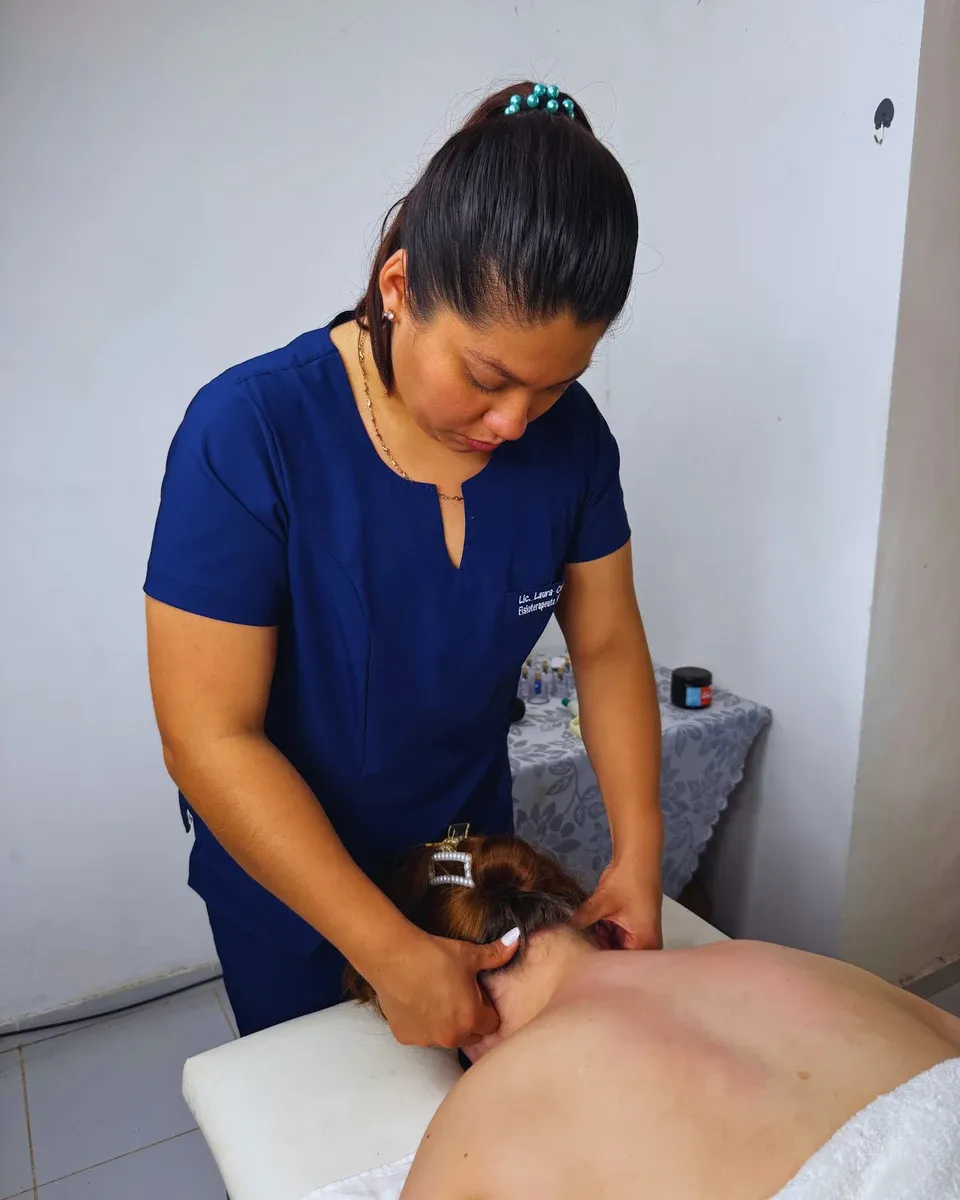
We use massage therapy and mobilization to release accumulated tension in the neck, shoulders, and back. Many patients feel relief in the first session, but that’s just the beginning.
Phase 2: Postural Correction
This is where the real change happens. I’ll show you exactly how you should sit, where your screen should be, and how to support your arms. You practice the correct posture until it becomes second nature.
Phase 3: Strengthening of stabilizing muscles
We perform specific exercises to strengthen the deep muscles of the back, core, and glutes. These muscles are what maintain your correct upright posture.
Phase 4: Stretching and flexibility
We lengthen the shortened muscles (chest, hip flexors, neck). Flexibility gradually returns.
Phase 5: Prevention and education
This is the most important step. I’ll teach you habits to prevent it from happening again. Because if you sit badly again, the problem will return.
Habits you should practice between sessions
Don’t expect 50 minutes of physiotherapy to undo years of sedentary behavior. The habits you practice at your desk are crucial:
During work
- Screen at eye level: Don’t tilt your head down. It should be at eye level.
- Feet flat on the floor: Don’t let your legs dangle. Both feet should be flat on the floor or a footrest.
- Back against the backrest: Support your entire back, not just part of it.
- Arms at a 90° angle: Your elbows should be at a right angle when you type.
- Every 30 minutes, get up: Walk for 1-2 minutes. Move around. Your body needs movement.
Simple stretches every hour
- Slowly turn your head to each side (10 seconds each)
- Tilt your head towards each shoulder (10 seconds each)
- Shrug your shoulders up and back 10 times slowly
- Stretch your arms back and open your chest (15 seconds)
- Stand up and arch your back slightly (10 seconds)
These five things take two minutes. Do them every hour. They will change your life.
At home
- Sleep in the correct position: On your side with a pillow that keeps your head aligned
- Avoid working from bed: If you work from home, use a proper desk
- Regular exercise: Walking, swimming, or gentle exercise 3 times a week speeds up your recovery
Price and access to physiotherapy in Santa Cruz
At Fisio Lau we offer sessions with personalized consultation, which includes:
- Personalized session
- Massage therapy and mobilization
- Personalized exercises
- Specific postural education
- Tracking your progress
- Initial assessment fully included
For sedentary work, we typically recommend 8-12 sessions (2-3 weeks) to see significant changes. Then, 1-2 sessions per month for maintenance.
Book your evaluation today
If you spend 8+ hours sitting in an office in Santa Cruz every day, your back is already complaining. Don’t wait until it hurts constantly.
Book your free postural assessment:
👉 Book my physiotherapy appointment
Tell me specifically where you feel the pain, whether it occurs during or after work, and how long you’ve been experiencing it. This will allow me to tailor your session to your specific needs related to a sedentary lifestyle.
Many office workers in Santa Cruz who have already visited Fisio Lau have returned to work pain-free. Their days at the office are no longer synonymous with suffering. You too can be in that group.
Laura Cortez Moza — Bachelor of Physiotherapy and Kinesiology · Santa Cruz de la Sierra, Bolivia